C Company, Chile

When an industrial site needs better effluent quality, the most attractive solution is not always a larger plant. Sometimes the real value lies in getting more out of the tanks already in place. This project shows how Kubota MBR technology was used to retrofit an existing beverage wastewater plant and deliver higher treatment performance within the existing layout.
Project snapshot
- Industry: Food & Beverage
- Capacity: 800 m³/day
- Influent: carbonated beverage wastewater
- Start-up: 2015
- Retrofit of the existing conventional activated sludge plant
- Installation in two phases: first 400 m3/day, then 800 m3/day
- Fine Bubble Diffuser Area (FBDA) and membranes in the same reactor
Why was the plant upgraded?
The site needed to improve treated water quality without moving to a full rebuild. Key drivers included achieving high effluent quality, upgrading the existing plant rather than replacing it, and expanding treatment capacity in a phased and practical way.
The challenge
Carbonated beverage wastewater can carry a high organic load, but the technical issue here was not only wastewater strength. The site needed to improve final effluent quality while working within the limits of the installed plant.
That meant the upgrade had to be compact, practical, and capable of delivering stronger performance from the existing infrastructure.
The solution
Kubota provided an MBR-based retrofit for the existing plant. The installation was carried out in two phases, starting at 400 m3/day with 8 g MLSS/L and later expanding to 800 m3/day with 12 g MLSS/L.
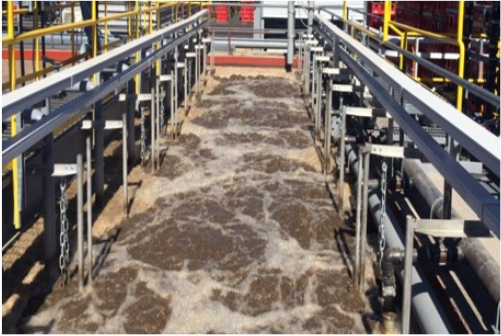
The system combined FBDA and membrane units in the same aeration tank to convert it into an MBR tank, creating a compact treatment concept while continuing to use the existing infrastructure. This gave the plant a practical route to higher capacity and better treated water quality without moving to a full rebuild.
Outcome
The retrofit improved treatment quality while making use of the existing site infrastructure.
Key outcomes include:
- Capacity of 800 m³/day, installation completed in two phases
- Retrofit of the existing plant
- FBDA and membranes in the same reactor
- BOD5 reduced from 1,250 mg/L to 5 mg/L
- Suspended solids reduced from 550 mg/L to 1 mg/L
What does this mean for similar plants?
If your plant needs better effluent quality but site conditions favor retrofit over rebuild, this project shows what a phased upgrade path can look like. It demonstrates how Kubota MBR can help increase capacity, improve effluent quality, and make better use of existing tanks, while keeping implementation practical and scalable.
On your side
On your side, when higher effluent quality has to come from the plant you already have.
![P Plant – Brazil [industrial]](https://onyourside.kubota-mbr.com/app/uploads/2026/04/P-Plant_Brazil_2-800x427.webp)
![I Dyeing Plant – India [industrial]](https://onyourside.kubota-mbr.com/app/uploads/2026/04/MBR-tank.png)
![N Plant – Japan [municipal]](https://onyourside.kubota-mbr.com/app/uploads/2026/04/Nakahama2-800x439.webp)
![Al Plant – Oman [municipal]](https://onyourside.kubota-mbr.com/app/uploads/2026/04/Al-Ansab-Reference-800x600.webp)
![C Plant – USA [municipal]](https://onyourside.kubota-mbr.com/app/uploads/2026/04/C-Plant-USA-MBR-Tank.png)
![EJ Plant – Spain [municipal]](https://onyourside.kubota-mbr.com/app/uploads/2026/04/Permeate-pipe-Guide-pipe-Air-pipe-800x1067.jpg)
![S Plant – Spain [municipal]](https://onyourside.kubota-mbr.com/app/uploads/2026/04/image-1.png)