
Renewing an aging urban treatment line for better effluent quality and combined sewer overflow control
Reference Case
N-plant, Japan
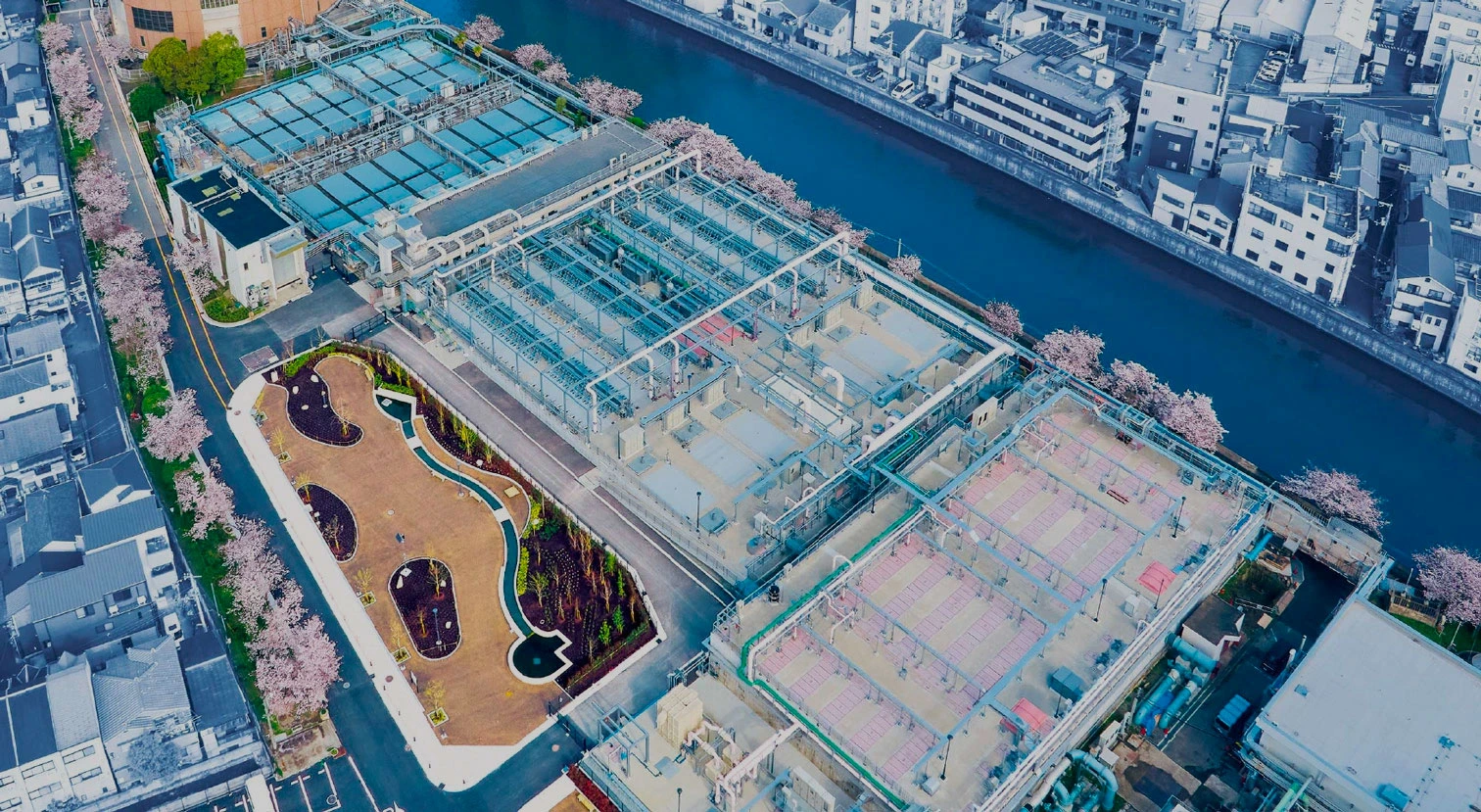
Urban wastewater treatment plants increasingly need to do more than continue operating as they always have. They need to be renewed within existing sites, deliver better effluent quality, respond better during wet weather, and remain practical to operate. N-plant, Japan, is a strong example of how Kubota helped renew the existing East treatment line by replacing the old conventional activated sludge process with a high-rate filtration system plus membrane bioreactor, while keeping reported energy consumption at 0.25 kWh/m3 of treated water.
Project snapshot
- Capacity of MBR: 40,000 m3/day* in dry weather and 96,000 m3/day in wet weather
- Capacity of high rate filtration: 40,000 m3/day in dry weather and 576,000 m3/day in wet weather
- Influent: municipal wastewater
- Start up: 2021
- Application: urban municipal wastewater treatment
- Renewal of the East treatment line by upgrading CAS to MBR plus high-rate filtration
- Submerged membrane units installed in existing aerobic tanks
- High-rate filtration installed instead of primary sedimentation to improve CSO control during wet weather
- First treatment of its kind in Japan, combining high-rate filtration and MBR
- Reported energy consumption: 0.25 kWh/m3 of treated water
*40,000 m3/day is the largest permanently installed MBR plant in Japan.
Why was the plant upgraded?
The East treatment line was an aging wastewater treatment line based on the conventional activated sludge process and had been operating since 1960. The municipality needed to renew this part of the plant while continuing to use the existing civil works, because there was no room for major new infrastructure.
At the same time, the renewed plant needed to deliver better effluent quality than the previous CAS process to protect the Higashi-Yokobori and Dontobori rivers, and consequently prevent the eutrophication of Osaka Bay. It also needed to improve control of combined sewer overflows during wet weather.
The challenge
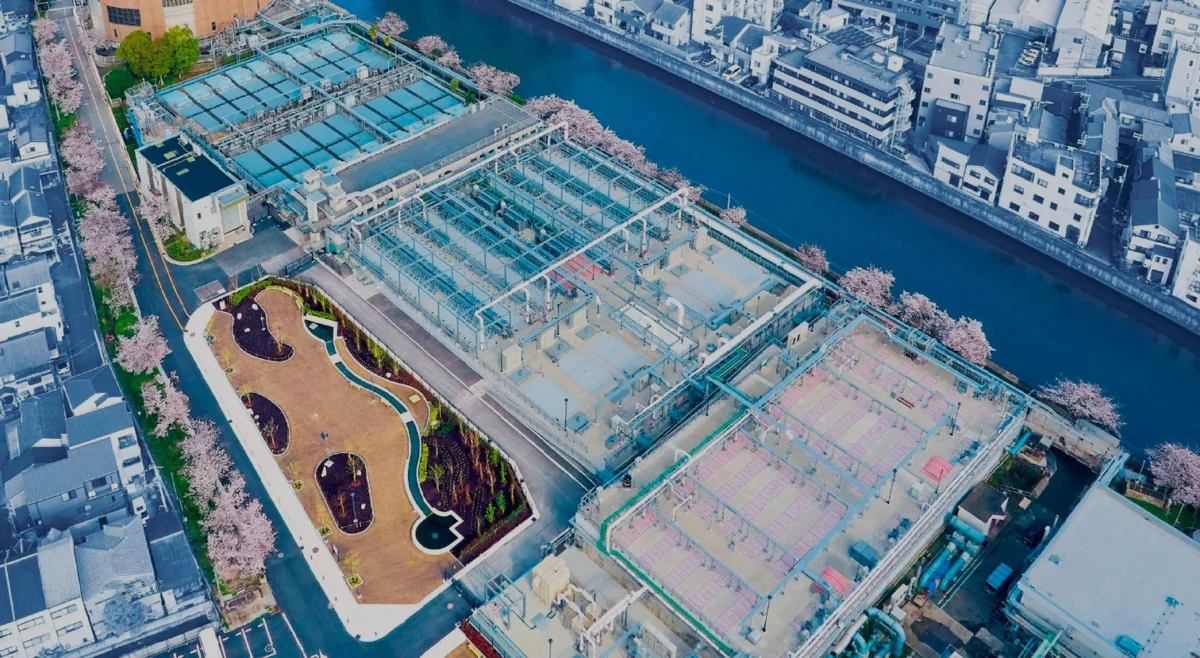
N Sewage Treatment Plant consists of an East treatment line, operating since 1960, and a West treatment line, operating since 1963, both originally based on the conventional activated sludge process. The renewal project focused on the East line.
The challenge was to renew the old treatment line by using the existing civil works, because there was no room to build major new infrastructure. At the same time, the renewed plant had to improve effluent quality, strengthen control of combined sewer overflows during wet weather, and keep energy consumption as low as possible. Kubota’s high-rate filtration plus MBR concept met those requirements. An additional benefit of the design was that it ultimately required less space than the old CAS configuration, because secondary sedimentation and disinfection were no longer needed. This was not the original requirement, but a welcome outcome for the municipality.
The solution
Kubota helped demonstrate that the combination of high-rate filtration and MBR was the most suitable solution for renewing the East treatment line by using the existing civil works.
The previous treatment train consisted of primary sedimentation, conventional activated sludge with aeration biological tanks, secondary sedimentation, and disinfection. The new treatment train consists of high-rate filtration instead of primary sedimentation and MBR instead of CAS. Secondary sedimentation and disinfection are no longer needed.
Submerged membrane units were installed in the existing aerobic tanks, converting them into membrane bioreactor tanks and enabling high-quality treated water production in a more compact layout. High-rate filtration was installed ahead of the MBR to strengthen wet-weather treatment capacity and improve CSO control. Because the floating filtration media removes nearly all debris, it also helps protect the downstream membranes from clogging and physical damage.
Keeping energy consumption of the renewed plant as low as possible was an important part of the project. Kubota combined several measures in one integrated concept. The SCRUM system controls the supply of supplemental air for biological treatment using an ammonium sensor, and also controls the scouring air needed to keep the membranes clean using a transmembrane pressure prediction model. In practice, the MBR requires two types of air: supplemental air for biological treatment and scouring air for membrane cleaning during operation. By helping dose the actual air flows required, the SCRUM system also helps reduce the energy consumption of the blowers, which account for more than 75% of the plant’s total energy demand.
Additional energy savings come from the use of air lift pumps to recirculate sludge from the membrane tanks to the anoxic tanks, using 95% less power than conventional recirculation pumps, and from siphon filtration for permeate extraction, using 99% less power than conventional membrane filtration pumps. Together, these measures help keep the operating energy demand of the renewed plant as low as possible.
How the process works in dry and wet weather
The combined high-rate filtration and MBR system is designed to respond differently under dry weather and wet weather conditions.
Under dry weather conditions, the average inlet flow of 40,000 m3/day passes first through the high-rate filtration system and then through the MBR.
Under wet weather conditions, the average inlet flow can increase to 96,000 m3/day. In that situation, the same 96,000 m3/day passes through the high-rate filtration system and can then be treated by the MBR for a maximum of 4 hours per day.
At peak wet weather conditions, a maximum daily inlet flow of 576,000 m3/day can pass through the high-rate filtration system. Of this, a maximum of 96,000 m3/day can be treated by the MBR for up to 4 hours per day. The remaining 480,000 m3/day can be bypassed as combined sewer overflow, but with an important advantage: the water quality is significantly better than the effluent from a conventional primary sedimentation process. This helps reduce pollutant loads during wet weather.
Outcome
The project demonstrates that compact renewal, advanced treatment, improved wet weather performance, and low energy consumption can be achieved together in an urban municipal plant.
Key outcomes include:
- Renewal of the East treatment line from CAS to high-rate filtration plus MBR
- Treatment capacity of 40,000 m3/day in dry weather for the MBR
- Wet weather MBR treatment capacity of 96,000 m3/day
- High rate filtration capacity of 576,000 m3/day in wet weather
- Reduction of pollutant loads during wet weather
- The largest permanently installed MBR plant in Japan at 40,000 m3/day
- The first treatment of its kind in Japan, combining high-rate filtration and MBR
- Improved CSO control during wet weather, as the high-rate filtration system can treat flows of up to 576,000 m3/day, while bypassed overflow still has a better quality than effluent from a conventional primary sedimentation process
- Reported energy consumption of 0.25 kWh/m3 of treated water.
What does this mean for similar plants?
N-plant is a strong example for municipalities that need to renew aging wastewater infrastructure without expanding the site, while also improving effluent quality and strengthening wet weather performance. It shows that high-rate filtration and MBR can work together as a practical renewal route when footprint, enhancing water quality, wet weather control, and operating efficiency all matter.
On your side
On your side, when urban wastewater treatment plant renewal has to improve water quality, wet weather control, and energy performance by using the existing facilities.
Browse our other case studies
![C Company – Chile [industrial]](https://onyourside.kubota-mbr.com/app/uploads/2026/04/MBR-tank-2.png)
![P Plant – Brazil [industrial]](https://onyourside.kubota-mbr.com/app/uploads/2026/04/P-Plant_Brazil_2-800x427.webp)
![I Dyeing Plant – India [industrial]](https://onyourside.kubota-mbr.com/app/uploads/2026/04/MBR-tank.png)
![Al Plant – Oman [municipal]](https://onyourside.kubota-mbr.com/app/uploads/2026/04/Al-Ansab-Reference-800x600.webp)
![C Plant – USA [municipal]](https://onyourside.kubota-mbr.com/app/uploads/2026/04/C-Plant-USA-MBR-Tank.png)
![EJ Plant – Spain [municipal]](https://onyourside.kubota-mbr.com/app/uploads/2026/04/Permeate-pipe-Guide-pipe-Air-pipe-800x1067.jpg)
![S Plant – Spain [municipal]](https://onyourside.kubota-mbr.com/app/uploads/2026/04/image-1.png)
1|7