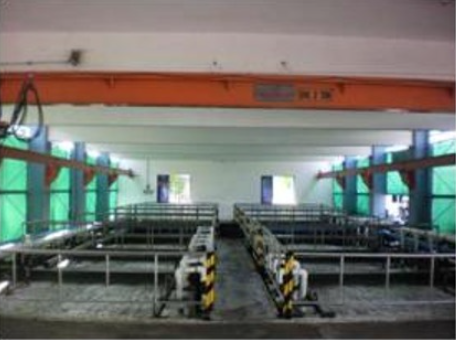
I Dyeing Plant, India

For textile and dyeing plants, wastewater treatment is often only one part of the challenge. The bigger issue is whether the treatment line can produce feed water of sufficient quality for downstream RO and support a credible zero liquid discharge strategy. This type of wastewater is also one of the most difficult industrial wastewaters to treat biologically because its low BOD/COD ratio indicates limited biodegradability.
In this project, Kubota MBR technology was used to strengthen RO feed quality and help make ZLD achievable. One of the key advantages of MBR in this application is its ability to operate at much higher MLSS concentrations than a conventional activated sludge process. While CAS typically operates at around 3,000 mg/L MLSS, Kubota’s MBRs can operate at MLSS higher than 12 mg/L., providing greater biological treatment capacity and increasing COD removal.
Project snapshot
- Industry: Textile – dyeing plant
- Capacity: 3,000 m³/day
- Influent: dyeing wastewater
- Start-up: 2010
- MBR applied to improve RO feed water quality
- Treatment of difficult wastewater in a more compact footprint than a CAS plant
- Long membrane life in a tough wastewater application, with only 6% of membrane cartridges replaced after 5 years of operation
- Final objective: zero liquid discharge
Why was the plant upgraded?
The treatment line had to do more than reduce pollution load. It had to support a wider water management objective. Key drivers included improving RO feed water quality, achieving zero liquid discharge, and maintaining reliable long-term membrane performance.
The challenge
Dyeing wastewater is difficult to treat consistently, especially when downstream RO performance matters. Because the RO feed requires stringent COD values, usually below 120 mg/L, the treatment system had to reduce the organic load far enough to protect the next step in the process and support stable day-to-day operation of the overall ZLD strategy. Footprint was also a limitation.
In this case, the challenge was not only to improve effluent quality and fit within a defined footprint, but to do so in a way that made the full treatment train perform more reliably.
The solution
Kubota provided an MBR-based treatment step to improve RO feed water quality ahead of the downstream reuse and concentration process. This created a stronger treatment barrier between the raw wastewater and the RO system, helping the plant move toward a ZLD operating concept.
For textile manufacturers, that is the real value of the solution. Better MBR performance upstream helps create a more dependable RO feed and a more robust overall water recovery strategy.
Outcome
The project shows how MBR can support both treatment improvement and a wider ZLD objective.
Key outcomes include:
- Capacity of 3,000 m³/day
- Zero liquid discharge achieved
- BOD5 reduced from 430 mg/L to 5 mg/L
- COD reduced from 960 mg/L to 120 mg/L
What does this mean for similar plants?
If your site depends on RO performance to make water recovery or ZLD viable, and footprint is a limiting factor, this project shows the value of strengthening the treatment step upstream. It demonstrates how Kubota MBR can help turn variable industrial wastewater into a more reliable feed stream for the next process stage.
On your side
On your side, when better RO feed quality is the key to zero liquid discharge and footprint is limited.
![C Company – Chile [industrial]](https://onyourside.kubota-mbr.com/app/uploads/2026/04/MBR-tank-2.png)
![P Plant – Brazil [industrial]](https://onyourside.kubota-mbr.com/app/uploads/2026/04/P-Plant_Brazil_2-800x427.webp)
![N Plant – Japan [municipal]](https://onyourside.kubota-mbr.com/app/uploads/2026/04/Nakahama2-800x439.webp)
![Al Plant – Oman [municipal]](https://onyourside.kubota-mbr.com/app/uploads/2026/04/Al-Ansab-Reference-800x600.webp)
![C Plant – USA [municipal]](https://onyourside.kubota-mbr.com/app/uploads/2026/04/C-Plant-USA-MBR-Tank.png)
![EJ Plant – Spain [municipal]](https://onyourside.kubota-mbr.com/app/uploads/2026/04/Permeate-pipe-Guide-pipe-Air-pipe-800x1067.jpg)
![S Plant – Spain [municipal]](https://onyourside.kubota-mbr.com/app/uploads/2026/04/image-1.png)